
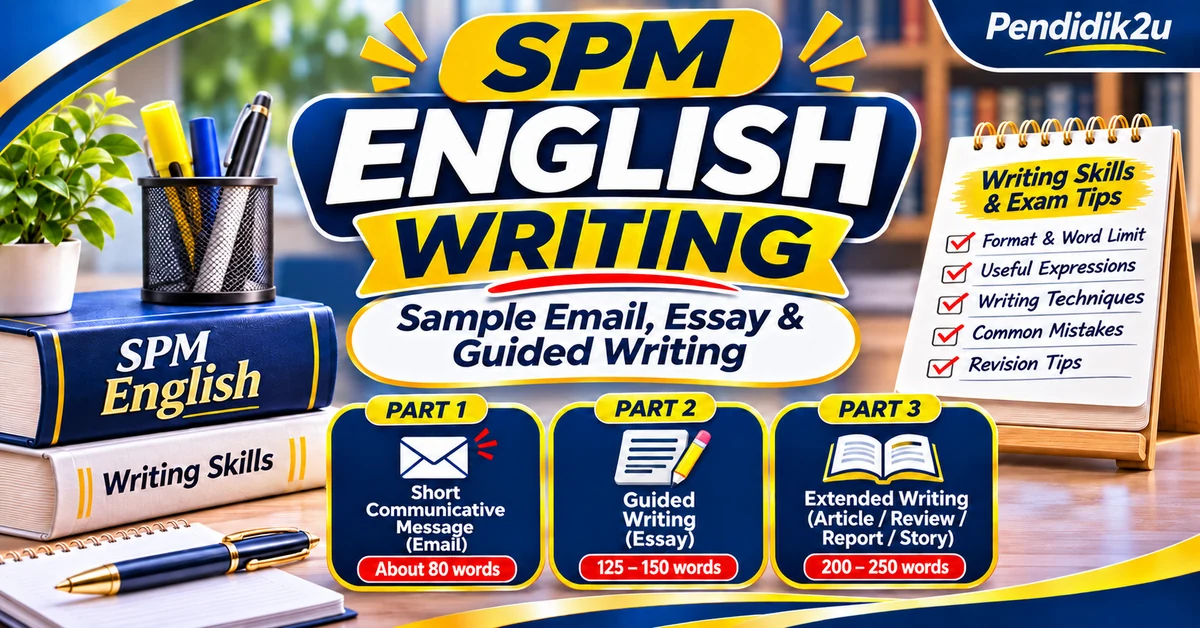
SPM English Writing is an important part of the Sijil Pelajaran Malaysia examination. Students are expected to communicate their ideas clearly, organise information effectively and use appropriate English for different writing tasks.
Updated: 12 November 2026
In SPM English Paper 2 (1119/2), candidates complete three writing sections: a short communicative message, guided writing and extended writing.
These sections test different writing skills. Students may need to reply to an email, write an essay based on given points or produce an article, review, report or story.
This guide provides sample SPM English emails, guided essays, extended-writing examples, useful expressions, writing techniques and examination tips for Form 4 and Form 5 students.
All sample questions and answers in this article are original practice materials prepared for learning purposes. They are not actual SPM examination questions or official marking schemes.
SPM English Paper 2 Writing Format
SPM English Paper 2 follows the CEFR-aligned assessment format introduced by the Malaysian Examinations Board (Lembaga Peperiksaan).
The paper is divided into three parts, with a total of 60 marks.
| Section | Writing task | Word limit | Marks |
|---|---|---|---|
| Part 1 | Short Communicative Message | About 80 words | 20 |
| Part 2 | Guided Writing | 125–150 words | 20 |
| Part 3 | Extended Writing | 200–250 words | 20 |
| Total | 90 minutes for the whole paper | — | 60 |
Candidates must answer Part 1 and Part 2. In Part 3, they must choose one of three questions.
The writing paper includes tasks that require candidates to demonstrate appropriate language, organisation and communication according to the purpose of the writing.
Understanding these requirements is the first step towards improving examination performance.
Part 1: SPM English Email Writing
Part 1 requires students to write a short communicative message of approximately 80 words.
The task commonly involves replying to an email from a friend, cousin or another person.
Candidates should read the message carefully and respond to all the points requested.
How to Write an SPM English Email
An effective email generally contains the following elements:
- Greeting: Start with an appropriate expression such as “Hi Aina” or “Dear Daniel”.
- Opening: Acknowledge the message and introduce your response.
- Main message: Answer every question or request in the task.
- Closing: End naturally with a suitable final sentence.
- Sign-off: Include an appropriate expression and name when relevant.
For informal emails, students should use friendly and natural language.
The most important requirement is to respond to the actual questions rather than memorising a long introduction.
Sample Email 1: Planning a School Trip
Practice question
Your friend, Aina, wants to organise a class trip. She asks you:
- Where should the class go?
- What activities can students do there?
- When should the trip take place?
- What should everyone bring?
Write an email to Aina in about 80 words.
Sample answer
Hi Aina,
Thanks for your email. I think we should visit the science centre because everyone can try interesting experiments. We could explore the space exhibition and join a robotics workshop. Both activities would be educational and fun.
Saturday would be a good day because our classmates are free. We should also bring water bottles and packed lunches to save money.
Let me know what you think so we can discuss the plan with our teacher.
See you soon!
Amir
Why this email works
The response answers all four points, gives reasons for the suggestions and maintains a friendly tone.
The writer also uses simple linking expressions such as “because” and “also” to connect ideas naturally.
Sample Email 2: Giving Advice About a Presentation
Practice question
Your friend, Daniel, is worried about an upcoming English presentation.
He wants to know whether he should use slides or read from a script. He also asks how to prepare and overcome nervousness.
Write an email giving your advice.
Sample answer
Hi Daniel,
Here is my advice for your English presentation. I suggest simple slides instead of a long script. Include pictures and short points to help the audience follow your ideas.
You should practise speaking aloud several times and time yourself. If you feel nervous, take a deep breath and look at friendly faces in the room.
Your classmates want you to do well!
I’m sure you’ll do well. Good luck, and tell me how it goes!
Best wishes,
Nadia
Writing tip: When giving advice, useful expressions include “I suggest”, “You should”, “Why don’t you” and “It would be a good idea to”.
Useful Expressions for SPM Email Writing
Students can improve their emails by learning expressions for different communicative purposes.
| Purpose | Useful expression |
|---|---|
| Greeting | Hi! How have you been? |
| Replying | It’s great to hear from you. |
| Giving advice | I think you should… |
| Making a suggestion | Why don’t you try…? |
| Giving a reason | This is a good idea because… |
| Expressing an opinion | In my opinion… |
| Accepting an invitation | I’d love to join you. |
| Declining politely | I’m sorry, but I won’t be able to attend. |
| Encouraging someone | I’m sure you can do it! |
| Closing | Write back soon! |
Avoid forcing too many expressions into a short email.
Choose only those that fit the task and keep your message clear.
Part 2: SPM English Guided Writing
Part 2 requires candidates to write a guided composition of approximately 125–150 words.
Students are usually given a topic accompanied by several points or questions to address.
Unlike Part 1, guided writing requires a more developed response with connected ideas.
Students should include all the required content while providing relevant examples and explanations.
How to Answer Guided Writing Questions
A simple approach is to organise the essay into four or five short paragraphs.
A practical structure is:
- Introduction: Introduce the topic.
- First body paragraph: Explain the first point.
- Second body paragraph: Develop the next point.
- Third body paragraph: Explain the remaining point.
- Conclusion: Summarise the main message.
The number of paragraphs is a writing strategy, not a compulsory examination rule.
Students should prioritise clear communication and ensure that all task requirements are addressed.
Sample Guided Writing 1: How to Stay Healthy
Practice question
Your class has been discussing healthy lifestyles among teenagers.
Your teacher asks you to write an essay about how teenagers can stay healthy.
In your essay, include:
- healthy eating habits;
- physical activities;
- the importance of sufficient sleep.
Use all the notes and give reasons for your views.
Sample answer
A healthy lifestyle is important because it helps teenagers stay active and concentrate at school. There are several simple habits we can practise every day.
First, we should eat balanced meals that include vegetables, fruit and protein. Drinking enough water is also better than choosing sugary drinks too often. For example, students can bring homemade lunches instead of buying snacks every day.
Next, regular exercise keeps our bodies strong and improves our mood. We can walk, cycle or play badminton with friends after school. These activities are enjoyable and do not always require expensive equipment.
Finally, teenagers need enough sleep. Putting phones away before bedtime can make it easier to rest properly. A consistent routine helps us wake up refreshed and ready to learn.
In conclusion, healthy eating, exercise and sufficient sleep can improve both our health and our school performance.
Writing analysis
This guided essay has a clear introduction, three developed points and a conclusion.
It uses familiar vocabulary, relevant examples and straightforward sentence structures.
Every main paragraph directly addresses one requirement from the question.
Sample Guided Writing 2: Benefits of Joining School Clubs
Practice question
Your teacher asks you to write an essay about the benefits of participating in school clubs.
In your essay, discuss:
- communication skills;
- teamwork and responsibility;
- friendships and personal development.
Sample answer
Joining a school club is a useful way for teenagers to learn outside the classroom. I believe every student should take part in at least one activity that matches their interests.
First, clubs help students develop communication skills. For example, members of a debate club learn to speak clearly and listen respectfully to different opinions. These skills are useful in school and later at work.
Second, club activities teach teamwork and responsibility. When students organise an event, they must share tasks, solve problems and meet deadlines. They also learn that other people depend on them.
Finally, clubs can reduce stress because students get opportunities to make friends and enjoy new experiences. A photography or gardening club, for instance, allows members to explore creative interests.
In short, school clubs build confidence, friendships and practical skills. Students should choose a club they enjoy and participate regularly.
Writing analysis
The essay explains three benefits of joining school clubs and supports each point with relevant details.
Expressions such as “First”, “Second”, “Finally” and “In short” make the organisation easy to follow.
How to Improve SPM Guided Writing
One useful technique is to develop each point using a simple sequence:
Point → Explanation → Example → Result
For example:
Point: Students should exercise regularly.
Explanation: Physical activity helps improve fitness and reduce stress.
Example: Teenagers can play badminton or cycle with friends.
Result: As a result, they may feel healthier and more energetic.
This approach helps students avoid writing isolated statements.
However, students should not follow a rigid formula when it makes their writing sound unnatural. They should focus on communicating their ideas effectively.
Part 3: SPM English Extended Writing
Part 3 requires students to choose one of three questions and write approximately 200–250 words.
Common task types include:
- Article
- Review
- Report
- Story
Each type has its own communicative purpose and appropriate style.
For example, an article may inform or persuade readers, while a review evaluates a place, product, book or experience.
Students should understand the conventions of each format before answering.
Sample Article for SPM English Writing
Sample 3: How Teenagers Can Use Technology Wisely
Practice question
Your school magazine is publishing an issue about digital technology.
Write an article about how teenagers can use technology responsibly.
In your article, explain the benefits of responsible technology use and suggest practical ways to develop healthy digital habits.
Sample answer
How Teenagers Can Use Technology Wisely
Technology is part of our everyday lives. We use phones to learn, communicate and relax. However, spending too much time online can affect our sleep, attention and relationships. The good news is that a few simple habits can help us enjoy technology without letting it control our lives.
First, set a clear purpose before opening an app. If you need to research a science project, focus on reliable websites and take notes. Avoid checking unrelated notifications until you finish your work. This small habit can save a surprising amount of time.
Next, create screen-free moments during the day. Put your phone away when eating with your family or talking to friends. These conversations help build stronger relationships and allow everyone to feel heard.
It is also important to protect your personal information. Use strong passwords, avoid suspicious links and think carefully before posting photos. Remember that something shared online may be difficult to remove completely.
Finally, make time for hobbies such as reading, sports or drawing. A balanced routine gives your mind and body a chance to recharge.
Technology should be a helpful tool, not your only source of entertainment. Start with one small change today, and encourage your friends to do the same.
Why this is an effective article
The article contains an appropriate title, introduction, several practical suggestions and a conclusion.
It also addresses readers directly, which is suitable for a school magazine article.
Sample Review for SPM English Writing
Sample 4: A Review of a Community Library
Practice question
Your school website invites students to review a place that is useful for studying.
Write a review of a library you have visited.
Describe its facilities, explain what you liked and disliked, and state whether you would recommend it.
Sample answer
A Library Worth Visiting
Last Saturday, I spent an afternoon at the new community library near my neighbourhood. I went there to prepare for a school project, but the experience was so enjoyable that I plan to return.
The first thing I noticed was the welcoming atmosphere. Large windows allowed natural light to enter, while comfortable chairs made the reading areas feel relaxing. The library also had clear signs, so finding the fiction and reference sections was easy.
My favourite feature was the quiet study room. Each table had enough space for books and a laptop, and there were charging points nearby. I completed most of my research without being distracted. Another useful facility was the digital catalogue, which helped me locate books quickly.
However, the library was crowded in the afternoon. I had to wait for a study seat, and the café offered only a few snacks. More seating and affordable food options would improve the experience.
Despite these small problems, I would recommend this library to students who need a peaceful place to study. The helpful staff, interesting books and comfortable environment make it worth visiting. I give it four out of five stars and look forward to my next visit.
Review-writing tips
A review should include a clear opinion supported by specific details.
Useful expressions include “My favourite feature was”, “One disadvantage was”, “I particularly enjoyed” and “I would recommend”.
Students should avoid simply describing a place without evaluating it.
Sample Report for SPM English Writing
Sample 5: A School Recycling Campaign
Practice question
Your school recently organised a recycling campaign.
As the secretary of the Environmental Club, write a report to the principal.
Your report should describe the activities, explain students’ responses and suggest improvements.
Sample answer
Report on the School Recycling Campaign
Introduction
This report describes the recycling campaign organised by the Environmental Club at our school last month. The campaign aimed to reduce waste and encourage students to practise recycling.
Activities
The programme began with a short talk by a local environmental volunteer. Students learned how to separate paper, plastic and metal. After the talk, volunteers placed clearly labelled recycling bins near the canteen and classroom blocks. Each class then collected recyclable materials for one week.
Response and Results
Most students participated enthusiastically. Several classes designed posters reminding others to keep food waste out of the recycling bins. By the end of the campaign, the club had collected numerous bags of paper and plastic. However, some bins contained mixed rubbish, showing that more guidance was needed.
Recommendations
I recommend displaying simple recycling instructions above every bin. Class monitors could also remind students about correct waste separation. The school should continue the campaign throughout the year rather than limiting it to one week. Teachers were also invited to share feedback, and the club recorded suggestions for next term’s activities.
Conclusion
Overall, the campaign was successful in raising awareness. With clearer instructions and regular monitoring, students can turn recycling into a lasting habit.
Prepared by:
Secretary, Environmental Club
Report-writing tips
A report should be factual, clearly organised and appropriate for the intended reader.
Headings can help separate the purpose, activities, findings and recommendations when suitable.
Avoid unnecessary personal comments and focus on relevant information.
Sample Story for SPM English Writing
Sample 6: The Bus I Almost Missed
Practice question
Your teacher asks you to write a story for the school magazine.
Your story must begin with the following sentence:
“I was running towards the bus stop when I heard someone shouting behind me.”
Write your story.
Sample answer
The Bus I Almost Missed
I was running towards the bus stop when I heard someone shouting behind me. The school bus was already waiting, and I knew I would be late if I stopped. Still, I turned around.
An elderly woman had dropped her shopping bag. Oranges were rolling across the pavement, and she was struggling to pick them up. I hesitated for a second before kneeling beside her.
“Don’t worry. I’ll help,” I said.
We gathered the fruit and checked that nothing was missing. She smiled and thanked me, but when I looked up, the bus had disappeared. My stomach sank. I had an important English presentation that morning.
Seeing my worried face, the woman asked what had happened. After I explained, she pointed towards a nearby shop. Her daughter worked there and could help me call the school.
A few minutes later, my teacher answered the phone. She told me to stay calm and take the next public bus. When I finally arrived, my classmates were waiting patiently. I gave my presentation with shaking hands, but it went better than expected.
After class, my teacher said, “You made a responsible choice today.”
I realised that missing one bus was inconvenient, but ignoring someone who needed help would have troubled me much longer.
Story-writing tips
A well-organised story usually contains an introduction, a problem, a series of events, a turning point and an ending.
Students should use suitable narrative tenses and include descriptions or dialogue where relevant.
Avoid introducing too many characters or events that cannot be developed within the word limit.
How Is SPM English Writing Assessed?
SPM English Writing is assessed using criteria that examine different aspects of a candidate’s response.
Teacher marking materials based on the CEFR-aligned format identify four main criteria.
| Criterion | What it assesses |
|---|---|
| Content | Whether the answer addresses the task and provides the required information |
| Communicative Achievement | Whether the text communicates effectively using an appropriate style and format |
| Organisation | Whether ideas are connected and logically structured |
| Language | The range and control of vocabulary and grammatical structures |
Each criterion is assessed using a scale in the relevant marking rubric.
Students should remember that sophisticated vocabulary alone does not guarantee a strong answer.
A response must also answer the question, communicate clearly and organise ideas appropriately.
Common SPM English Writing Mistakes
Some mistakes can be avoided through careful planning and proofreading.
| Common mistake | How to improve |
|---|---|
| Missing a required point | Underline each task requirement before writing |
| Writing too far beyond the suggested length | Plan how much detail each paragraph needs |
| Using an inappropriate tone | Identify the target reader and writing purpose |
| Repeating the same ideas | Create a short outline first |
| Making frequent grammar mistakes | Use sentence structures you can control |
| Writing without paragraph breaks | Group related ideas together |
| Using connectors incorrectly | Choose linking words based on meaning |
| Forgetting to proofread | Reserve a few minutes to check the final answer |
A useful habit is to check every sample essay against the original question.
Ask yourself: “Have I answered everything the reader needs to know?”
Useful Linking Words for English Essays
Linking words help readers follow the development of ideas.
| Purpose | Examples |
|---|---|
| Adding information | Furthermore, Moreover, In addition |
| Showing sequence | First, Next, Finally |
| Giving examples | For example, For instance |
| Showing contrast | However, Nevertheless, On the other hand |
| Explaining reasons | Because, Since, As |
| Showing results | Therefore, As a result, Consequently |
| Concluding | In conclusion, To sum up, Overall |
These expressions should be used appropriately rather than inserted into every sentence.
For example, “However” introduces contrast, while “Therefore” introduces a result or logical conclusion.
Understanding their functions is more useful than memorising a long list.
Time Management for SPM English Paper 2
Candidates have 90 minutes to complete the writing paper.
The following is a suggested way to divide the available time.
| Writing section | Suggested time |
|---|---|
| Part 1: Short Communicative Message | 15 minutes |
| Part 2: Guided Writing | 25 minutes |
| Part 3: Extended Writing | 45 minutes |
| Final checking | 5 minutes |
| Total | 90 minutes |
This schedule is a revision strategy, not an official requirement.
Students can adjust their time allocation according to their writing speed and personal strengths.
However, they should avoid spending too much time on Part 1 and leaving insufficient time for Part 3.
SPM English Writing Practice Topics
Students can develop their skills by practising different themes and task types.
Here are some original practice suggestions.
| Writing task | Suggested topic |
|---|---|
| Advising a friend about revision | |
| Suggesting a place for a family holiday | |
| Guided Writing | Benefits of volunteering |
| Guided Writing | Ways to stay physically active |
| Guided Writing | Importance of reading |
| Article | How teenagers can save money |
| Article | Ways to protect the environment |
| Review | A book or film worth recommending |
| Review | A favourite place to visit |
| Report | A school health campaign |
| Report | An educational trip |
| Story | An unexpected act of kindness |
These topics are provided for practice. They are not predictions of future SPM questions.
A Simple Weekly SPM Writing Revision Plan
Students can use a short weekly routine to improve their writing consistently.
| Day | Activity |
|---|---|
| Monday | Read two sample emails and write one reply |
| Tuesday | Practise a guided essay |
| Wednesday | Learn useful vocabulary and linking expressions |
| Thursday | Write an article or review |
| Friday | Practise a report or short story |
| Saturday | Complete a timed writing exercise |
| Sunday | Review mistakes and rewrite weak paragraphs |
Students who struggle with grammar may begin with shorter sentences before attempting more complex structures.
The aim is to develop accuracy, confidence and flexibility rather than memorising entire model answers.
Frequently Asked Questions About SPM English Writing
1. How many parts are there in SPM English Writing Paper 2?
There are three parts: Short Communicative Message, Guided Writing and Extended Writing.
2. How many marks is SPM English Paper 2 worth?
The writing paper carries 60 marks, with 20 marks allocated to each part.
3. How many words should I write for SPM email writing?
Part 1 generally requires a response of about 80 words.
4. What is the word limit for SPM guided writing?
Part 2 requires approximately 125–150 words.
5. How many words are required for SPM extended writing?
Part 3 requires approximately 200–250 words.
6. Must I answer all three questions in Part 3?
No. Candidates are given three choices and must answer only one.
7. Which is easier: an article, report, review or story?
The most suitable choice depends on how well the candidate understands the question and can develop relevant ideas.
Students should choose the task they can answer most effectively.
8. Do I need advanced vocabulary to score well?
Appropriate vocabulary is important, but clarity, task fulfilment, organisation and grammatical accuracy also matter.
9. Can I memorise sample essays for SPM?
Reading model essays can help students learn structures and useful expressions. However, memorising entire essays is not recommended because actual examination questions may require different content.
10. How can I improve my SPM English writing quickly?
Practise regularly, learn from corrected mistakes, study suitable model answers and write under timed conditions.
Improvement is more likely when students review feedback and apply it to their next piece of writing.
Additional SPM Revision Resources
Students who are preparing for other SPM subjects may also find the following resources useful.
Pendidik2u – Contoh Karangan Bahasa Melayu SPM
A collection of Bahasa Melayu essay examples, writing techniques and revision guidance.
Pendidik2u – Koleksi Soalan SPM
A collection of past SPM examination resources organised by year and subject. Check the examination year and syllabus before using older questions.
Conclusion
SPM English Writing becomes easier to manage when students understand the requirements of each section and practise using the appropriate writing style.
Part 1 focuses on short communication, Part 2 develops guided essay-writing skills, and Part 3 allows candidates to demonstrate their ability to write longer texts for different purposes.
By studying sample emails, guided essays, articles, reports, reviews and stories, students can learn how to develop ideas, connect sentences and communicate more confidently.
The most effective preparation involves regular writing, thoughtful revision and feedback from teachers.
Use the examples in this guide as models, but develop your own ideas and adapt them to the actual examination questions.
Sources and References
- Lembaga Peperiksaan – SPM English CEFR-Aligned Assessment Format. An archived copy of the official assessment-format document shared by PSS Al-Biruni SMKBRP.
- SPM English 1119 – Teacher Learning Resources. Teaching materials and Paper 2 writing resources.
- Ministry of Education Malaysia. Official announcements and examination information.
Prepared by Pendidik2u. Updated on 12 November 2026. The model answers and practice questions are original educational examples and are not official examination questions or grading guarantees.